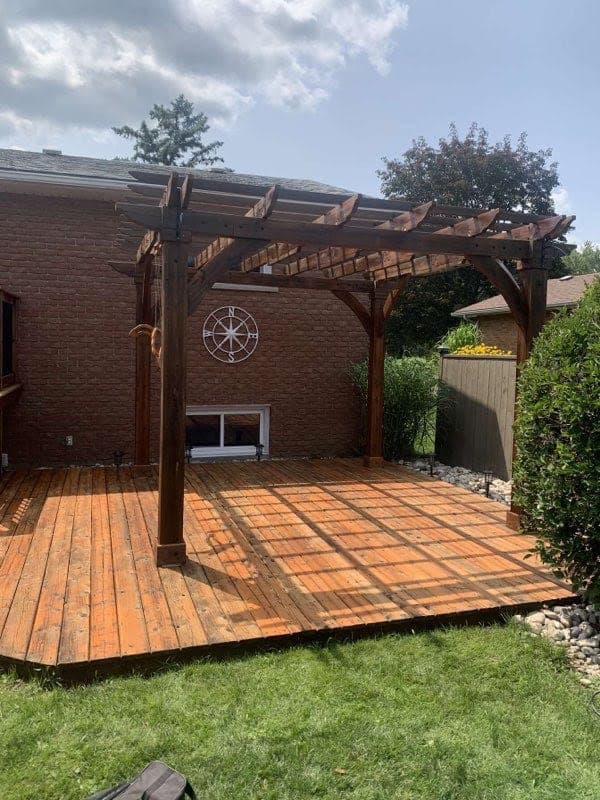
Helpful tips/Stains·8 min read·Updated September 5, 2026
Every stain finish trades wood visibility for coverage. Here is how transparent, semi-transparent, semi-solid, and solid options actually compare in practice.
Key takeaways
- 1Deck stain exists on a spectrum from transparent, which shows the most wood grain, to solid, which behaves closest to paint and hides the most.
- 2Semi-transparent is the most requested option across Kitchener-Waterloo because it balances visible wood grain with strong UV and moisture protection.
- 3Older or heavily weathered wood often looks better under a semi-solid or solid finish, since more coverage hides imperfections that a transparent stain would highlight.
- 4All four options at Restore My Deck are premium penetrating oil-based products, including Ready Seal and Penofin Verde, brush-applied rather than sprayed.
- 5The right choice depends on wood condition, desired look, and how much of the natural grain you want visible, not on which option lasts longest, since all are maintained on a similar cycle.
One of the more common questions homeowners across Kitchener-Waterloo ask before a staining project is which finish level to choose: transparent, semi-transparent, semi-solid, or solid. These four options sit on a spectrum, from stains that let almost all of the wood grain show through to finishes that behave much more like paint, and the right choice depends less on which one is objectively best and more on the condition of your wood and the look you are after. This guide walks through what actually separates the four and how to think about the decision for your own deck.
The spectrum, explained simply
All deck stains work by depositing pigment and protective oils into the wood, but the amount of pigment is what changes the level of coverage and, in turn, how much of the wood's natural grain and colour variation remains visible once the finish cures. Transparent stain carries the least pigment and shows the most wood character, including grain patterns and natural colour variation, while adding UV and moisture protection without significantly changing the wood's appearance. Semi-transparent carries more pigment, enough to introduce a consistent tone while still letting the grain show through clearly. Semi-solid carries still more pigment, muting the grain into a softer, less pronounced pattern while introducing a more uniform colour. Solid carries the most pigment and behaves closest to a stain-paint hybrid, largely obscuring the wood grain in favour of a flat, even, opaque colour.
Transparent stain: for wood you want to show off
Transparent stain makes the most sense on decks with attractive, relatively even-toned wood where the goal is protection without meaningfully changing the appearance. It works particularly well on newer cedar or high-quality lumber where the grain pattern itself is a selling point. Because it carries the least pigment, transparent stain also tends to need slightly more frequent attention within the 2 to 4 year maintenance window, since there is less pigment to buffer against UV fading. It is a less common choice locally than semi-transparent, largely because most decks benefit from at least some added colour consistency, but it remains the right call for wood in excellent condition that a homeowner wants to keep looking as close to natural as possible.
Semi-transparent: the most popular choice locally
Semi-transparent stain is the option most Kitchener-Waterloo homeowners choose, and for good reason. It strikes a balance that most people find appealing: enough pigment to even out minor colour inconsistencies and give the deck a warmer, richer tone, while still allowing the wood grain to show through clearly. This makes it forgiving of small imperfections without hiding the character of the wood entirely, and it performs well across both cedar and pressure-treated lumber once properly prepped. Because it is the most frequently requested finish, Restore My Deck has extensive experience achieving consistent, even results with semi-transparent stain across a wide range of deck conditions and layouts.
Semi-solid: a middle ground for less-than-perfect wood
Semi-solid stain is worth considering when a deck's wood has enough discolouration, patchy weathering, or old stain residue that a semi-transparent finish would highlight those inconsistencies rather than hide them. With more pigment than semi-transparent, semi-solid can even out uneven tones while still leaving a hint of the wood grain visible, which keeps it from looking as flat and uniform as a fully solid finish. This makes it a practical option for older decks, decks that have gone several years without maintenance, or decks with mismatched boards from a partial repair, where full transparency would draw attention to differences between old and new wood rather than blending them together.
Solid: closest to paint, and when that makes sense
Solid stain provides the most coverage and the most uniform, opaque colour of the four options, largely hiding the wood grain in favour of a flat, consistent finish. This is the right choice for decks in rougher condition, where sun damage, old peeling paint, mismatched repairs, or significant discolouration make an even, opaque colour more appealing than trying to preserve or highlight the wood's natural look. Solid stain can also be a good fit for homeowners who simply prefer the aesthetic of a painted-looking deck over a wood-grain look, independent of the wood's condition. Because it carries the most pigment, solid stain also tends to hide fine surface imperfections that would otherwise show through a lighter finish, though it will not disguise structural issues like soft or rotted boards, which need repair rather than a heavier coat.
How wood condition should guide the decision
A useful way to think about the choice is to start from the condition of the wood rather than a preferred look in isolation. Wood that is in excellent shape, evenly toned, and free of significant old finish or damage can support any of the four options purely as an aesthetic choice. Wood that has visible discolouration, patchy old stain, or mismatched replacement boards benefits from more coverage, generally semi-solid or solid, since more pigment does more work to blend those inconsistencies into a uniform result. This is one of the things assessed during a Restore My Deck quote, whether from photos or an on-site visit, since recommending the right finish level for the actual condition of your wood produces a better outcome than defaulting to whatever finish a homeowner initially had in mind.
How application changes across finish levels
Regardless of which finish level you choose, Restore My Deck applies all four using the same core process: premium penetrating oil-based stains, including Ready Seal and Penofin Verde, brush-applied rather than sprayed. Brushing pushes the product into the wood fibre more thoroughly than spraying, which matters across the full spectrum but especially for solid and semi-solid finishes, where even coverage across every board is essential to avoid visible lap marks or streaking. The full four-step process, clean, repair, sand and stain, and final inspection, is the same across all finish levels, since proper prep matters just as much for a solid finish as it does for a transparent one.
Maintenance expectations across the four options
All four finish levels are maintained on a broadly similar cycle: a re-stain roughly every 2 to 4 years, with a fuller restoration every 5 to 7 years. Transparent stain, carrying the least pigment, may show wear slightly sooner in high-UV areas, while solid stain's heavier pigment load can offer marginally more visible fade resistance, though none of the four are meaningfully lower-maintenance than the others in a practical sense. The bigger factor in how long a finish lasts is proper prep and application quality rather than which point on the transparency spectrum you choose.
Choosing the right finish for your deck
If you are still unsure which option makes sense, the most reliable approach is to send photos of your deck through /contact and get a recommendation as part of your free quote. Cameron and the Restore My Deck team can look at the current wood condition, discuss the look you are after, and suggest the finish level that will produce the best result rather than leaving it as a guess. You can also call 226.476.2055, Monday to Friday, 8 AM to 5 PM, to talk through the options directly before booking your project.
Frequently asked questions
Which stain finish is most popular in Kitchener-Waterloo?
Semi-transparent is the most requested option locally. It balances visible wood grain with strong UV and moisture protection and works well on both cedar and pressure-treated decks.
Does solid stain last longer than semi-transparent?
Not meaningfully. All four finish levels are maintained on a roughly similar 2 to 4 year re-stain cycle. Proper prep and application matter more to longevity than the finish level chosen.
Should I choose solid stain if my deck has old peeling paint?
Often, yes. Solid or semi-solid stain provides more coverage and can even out discolouration or mismatched boards better than a lighter, more transparent finish would.
Can I switch from a solid stain to a semi-transparent one later?
It depends on how much pigment has built up in the wood over past applications. This is worth discussing during a quote, since some wood needs more aggressive stripping and sanding to move to a lighter finish.
Are all four finish levels applied the same way?
Yes. Restore My Deck brush-applies all four using premium penetrating oil-based stains, including Ready Seal and Penofin Verde, following the same four-step process: clean, repair, sand and stain, and final inspection.
How do I know which finish is right for my deck?
Send photos through /contact for a free quote and recommendation based on your wood's current condition and the look you want. Wood condition, more than personal preference alone, often points toward the right choice.
Free quote
Want us to just handle it?
Send a few photos of the deck and we will come back with a price within 24 hours.
Keep reading
Stains · 8 min
Oil-Based vs Water-Based Deck Stain: Which Is Right for You?
Oil-based and water-based deck stains work in fundamentally different ways, and in a climate with 40-plus freeze-thaw cycles a year, that difference decides whether your stain fades gracefully or peels.
Stains · 8 min
Cedar vs Pressure-Treated Decks: How Staining Differs
Cedar and pressure-treated lumber respond to stain differently. Here is what changes in the cleaning, sanding, and finishing process between the two wood types.
Costs · 8 min
How Much Does Deck Staining Cost in Kitchener-Waterloo
Deck staining quotes in Kitchener-Waterloo vary more than most homeowners expect. Here is what actually drives the price and what a fair quote should include.