Helpful tips/Process·8 min read·Updated September 5, 2026
Pressure washing feels like the obvious way to clean a deck, but used incorrectly it's one of the most common causes of premature damage. Here is how professionals actually decide between pressure and soft washing.
Key takeaways
- 1Consumer pressure washers often run 1,500 to 2,500+ PSI, well above the 800 to 1,200 PSI professionals use on most residential deck wood.
- 2Soft washing relies on cleaning chemistry, sodium percarbonate, wood brighteners and surfactants, to break down mold and staining without mechanical force.
- 3Professional deck cleaning combines both methods in sequence: pre-wet, apply cleaner, dwell, agitate if needed, rinse at controlled pressure, then brighten if necessary.
- 4Over-pressured DIY washing raises the wood grain, leaves visible streaks and can strip away surface wood, damage that usually requires extra sanding to correct.
- 5Older cedar, composite decking, decks with failing stain and painted surfaces are cases where soft washing, not pressure, is the required approach.
Ask most homeowners to picture cleaning a deck and they imagine a pressure washer blasting years of grime off the wood in a single satisfying pass. Pressure washing is a genuine part of professional deck restoration, but used incorrectly it's also one of the most common causes of premature deck damage we see across Kitchener, Waterloo and the surrounding area. Soft washing, the lower-pressure, chemistry-led alternative, is often the smarter starting point. Here is how professionals actually approach this decision, and why the sequence matters more than most people assume.
What pressure washing actually does
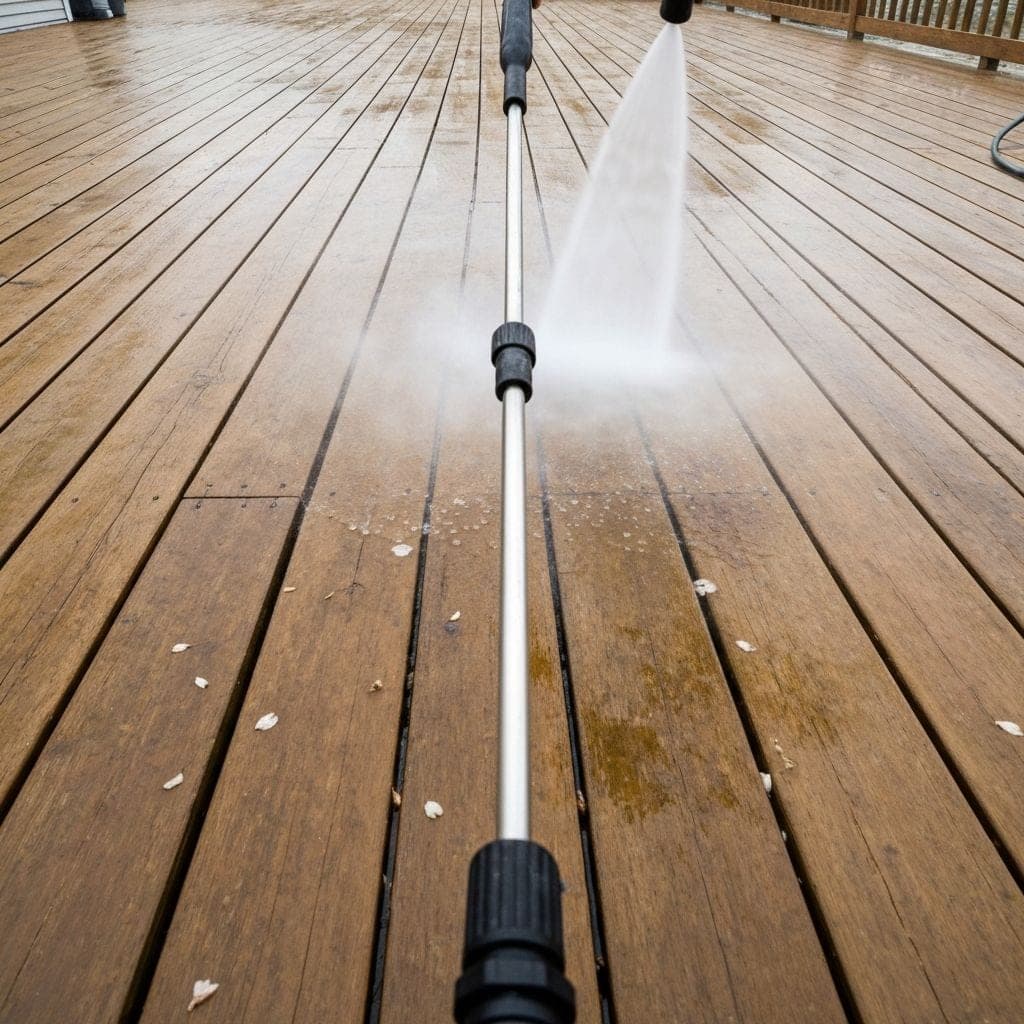
Pressure washing uses high-pressure water, typically anywhere from 800 to 3,000-plus PSI depending on the machine, to mechanically strip dirt, old stain, mold and weathered surface material off wood. At the right pressure it's highly effective. At too high a pressure it raises the wood grain, splinters the surface, drives water deep into the boards and can structurally erode softer wood species. For most residential deck wood in this region, pressure-treated pine, cedar and SPF, professional crews use 800 to 1,200 PSI with a wide fan tip, typically 25 or 40 degrees. Going above 1,500 PSI on softwood risks visible damage, the grain raises and the surface feels rough even once it's dried. Above 2,000 PSI, the wood surface itself can start to physically erode.
What soft washing actually does
Soft washing uses low pressure, typically 100 to 500 PSI, roughly what a garden hose delivers on a high setting, combined with specialized cleaning solutions that do the work chemically rather than mechanically. The chemistry carries the load. Sodium percarbonate or oxygen bleach breaks down mold, algae and mildew at the cellular level without damaging the wood itself. Wood brighteners, typically oxalic acid based, neutralize tannin staining and restore an even, fresh colour to weathered grey wood. Surfactants help the cleaning solution penetrate deeply into the wood grain and lift out embedded dirt that surface rinsing alone would miss. The solution dwells on the wood for 10 to 20 minutes before being rinsed off with low pressure, no grain raising, no splintering, just chemistry doing what brute force can't accomplish safely.
How professionals combine both methods
The most effective deck cleaning uses both approaches together, and the sequence is what makes it work. It starts with pre-wetting the deck with plain water, which prevents the cleaning solution from drying too quickly in direct sun. Next, the soft wash cleaning solution goes on and is left to dwell, since this is where most of the actual cleaning happens, not the rinse step people usually picture. Stubborn areas get agitated with a stiff brush if needed. Then comes a rinse at low-to-moderate pressure, generally 800 to 1,000 PSI, to remove the loosened solution and debris, always working with the grain rather than across it. If the wood is significantly weathered, a wood brightener is applied at this stage to restore its natural colour before a final rinse and full drying period ahead of sanding or staining.
- Pre-wet the deck with plain water to slow drying in direct sun
- Apply the soft wash cleaning solution and let it dwell 10 to 20 minutes
- Agitate stubborn areas with a stiff brush if needed
- Rinse at controlled low-to-moderate pressure, working with the grain
- Apply wood brightener on significantly weathered wood, then final rinse and dry
Using this combined method cleans a deck more thoroughly than high-pressure washing alone, and it does so with zero grain damage, which matters directly for how well the subsequent stain coat penetrates and lasts.
The DIY pressure washer problem
Consumer pressure washers from hardware stores often run 1,500 to 2,500-plus PSI and come with narrow-angle nozzles that concentrate that pressure into a tight, aggressive stream. Many homeowners run these at full pressure with a 0 or 15 degree tip, which can visibly streak and fuzz a wood surface in a single pass. The resulting damage typically shows up once the deck dries: raised, rough, fuzzy grain texture, visible streaks running with the grain direction, distinct cleaning lines where overlapping passes met, and lighter patches where surface wood was actually stripped away.
- Raised, rough or fuzzy surface texture after drying
- Visible streaking running along the grain direction
- Distinct lines where overlapping passes met
- Lighter, uneven patches where surface wood has been removed
This kind of damage doesn't mean the deck is ruined, it can usually be sanded smooth, but it adds time and cost to the restoration process. Avoiding it is straightforward in principle: use a wide-angle tip of 25 or 40 degrees, stay at least 12 inches from the surface, and keep the wand moving continuously rather than lingering in one spot.
Special cases where soft washing is mandatory
Certain situations call for soft washing exclusively, with minimal or no pressure at all. Older, weathered cedar softens as it ages and can be significantly damaged by high pressure, making soft washing the safer default. Composite decking is another clear case, most manufacturers specify a maximum of 1,000 to 1,500 PSI from at least 8 to 12 inches away, and some composite systems call for soft washing only. Decks with existing failing or peeling stain are a third case, since high pressure over that finish spreads fragments across the deck surface and into every crevice rather than cleanly removing it. And painted decks, where the goal is preserving rather than stripping the existing finish, are safest handled with soft washing only.
- Older, weathered cedar, which softens with age and damages easily under pressure
- Composite decking, where manufacturer specs usually cap PSI well below typical wood settings
- Decks with existing peeling or failing stain, where pressure spreads fragments instead of removing them cleanly
- Painted decks, where the goal is preserving rather than stripping the existing finish
Why this decision matters for the rest of the restoration
How a deck is cleaned directly affects every step that follows. Over-pressured cleaning that raises the grain or strips surface wood means more aggressive sanding is needed afterward to correct it, adding time to the project. Under-cleaned wood, meanwhile, traps mold, algae and old finish residue underneath a new stain coat, which is one of the fastest ways to shorten that stain's lifespan regardless of how good the product is. Getting the pressure-versus-chemistry balance right the first time is what sets up the rest of the process, an 80-grit buff sand and a brush-applied premium oil-based stain, for the best possible result. See /how-to-prepare-your-deck-for-staining for how the full preparation sequence fits together.
The bottom line
Effective deck cleaning isn't about maximizing pressure, it's about using the right combination of chemistry and controlled pressure for the specific wood species, finish condition and level of contamination on that particular deck. Professional crews dial in each of those variables on every job, while DIY approaches with consumer equipment often lean on too much pressure and too little chemistry, which is exactly backwards. If your deck needs a proper clean before restaining, or if it's been years since it had any real attention, Restore My Deck handles the full process, clean, repair, sand and stain, using the right tools and technique for your specific deck. Send photos through /contact-us for a free quote, or call 226.476.2055, Monday to Friday, 8 AM to 5 PM.
Frequently asked questions
What PSI should be used to pressure wash a deck?
Professional crews typically use 800 to 1,200 PSI with a wide 25 or 40 degree fan tip on most residential deck wood. Consumer pressure washers often run 1,500 to 2,500-plus PSI, which risks raising the grain or damaging the surface on softwoods.
What's the difference between pressure washing and soft washing?
Pressure washing uses high-pressure water, typically 800 to 3,000-plus PSI, to mechanically strip dirt and old finish off wood. Soft washing uses low pressure, around 100 to 500 PSI, combined with cleaning chemistry that breaks down mold, algae and staining without mechanical force.
Can pressure washing damage my deck?
Yes, if the pressure is too high or the nozzle too narrow. Over-pressured washing raises the wood grain, creates visible streaking and cleaning lines, and can strip away surface wood, damage that usually requires additional sanding to correct before staining.
When is soft washing required instead of pressure washing?
Older, weathered cedar, composite decking, decks with existing peeling stain, and painted decks all call for soft washing rather than pressure washing, since high pressure on these surfaces causes damage or spreads failing finish rather than cleaning it properly.
Do professionals use pressure washing or soft washing, or both?
Both, in sequence. A typical professional clean pre-wets the deck, applies a soft wash cleaning solution that dwells for 10 to 20 minutes, agitates stubborn spots, then rinses at controlled low-to-moderate pressure, sometimes followed by a wood brightener on significantly weathered wood.
My deck already has streaks from a DIY pressure wash, is it ruined?
No, in almost every case that kind of surface damage can be sanded smooth as part of a professional restoration. It adds a step to the process but doesn't mean the deck itself needs to be replaced.
Free quote
Want us to just handle it?
Send a few photos of the deck and we will come back with a price within 24 hours.
Keep reading
Process · 8 min
How to Prepare Your Deck for Staining: A Step-by-Step Guide
The number one reason deck stain fails within a year has nothing to do with the product. It is the prep work underneath it. Here is the sequence professional crews follow before any stain touches the wood.
Costs · 8 min
How Much Does Deck Staining Cost in Kitchener-Waterloo
Deck staining quotes in Kitchener-Waterloo vary more than most homeowners expect. Here is what actually drives the price and what a fair quote should include.
Maintenance · 8 min
How Often Should You Restain Your Deck? A Practical Guide
The calendar is only a starting point. Here is how to read your own deck's condition, understand what Ontario's climate does to stain, and know exactly when it's time to restain rather than wait another season.