Helpful tips/Fences·8 min read·Updated September 5, 2026
Paint and stain protect a fence in fundamentally different ways, and that difference shows up most clearly once the finish starts to age. Here is how they compare.
Key takeaways
- 1Paint sits on top of the wood as a film, while penetrating oil-based stain soaks into the fibre, and that structural difference is what determines how each ages over time.
- 2Paint eventually cracks, chips, and peels as wood expands and contracts with temperature and moisture, requiring scraping and prep before it can be redone.
- 3Stain fades gradually rather than peeling, and refreshing it typically means cleaning and re-coating rather than the more labour-intensive process paint failure requires.
- 4Southwestern Ontario's freeze-thaw winters put extra stress on any exterior wood finish, and stain generally tolerates that movement better than a rigid paint film.
- 5Restore My Deck applies premium penetrating oil-based stains, including Ready Seal and Penofin Verde, brush-applied for deeper penetration on fences as well as decks.
When a wooden fence needs a fresh finish, the choice often comes down to paint or stain, and the two are not simply different colours of the same product. They work in fundamentally different ways, and that difference is what determines how each one ages, particularly across Kitchener-Waterloo's freeze-thaw winters and humid summers. This guide compares how paint and stain perform over time on a fence, and why one tends to hold up better under the specific conditions this region sees.
How paint and stain actually work differently
Paint is a film-forming product. It sits on top of the wood surface, creating a continuous layer that seals the wood underneath and provides its colour and protection from that surface layer. Penetrating oil-based stain, by contrast, is designed to soak into the wood fibre itself rather than sit on top of it, carrying pigment and protective oils down into the grain. This is not a minor technical distinction; it is the reason the two products fail in completely different ways once they start to age, and it is the core reason stain tends to hold up better on exterior wood structures like fences over the long run.
Why paint eventually cracks and peels
Wood is not a static material. It expands and contracts with changes in temperature and moisture, swelling in humid summer conditions and contracting in dry, cold winter air. A paint film, because it sits on the surface as a separate layer, does not move with the wood underneath it in the same way. Over time, that mismatch causes the paint film to crack, and once cracks form, moisture gets underneath the film and accelerates peeling. This is a normal, expected failure mode for exterior paint on wood, not a sign of poor-quality product, and it is why painted fences eventually need scraping, sanding, and full repainting once the film starts to fail, a more labour-intensive process than most homeowners expect when they first choose paint for the lower upfront look.
Why stain fades instead of peeling
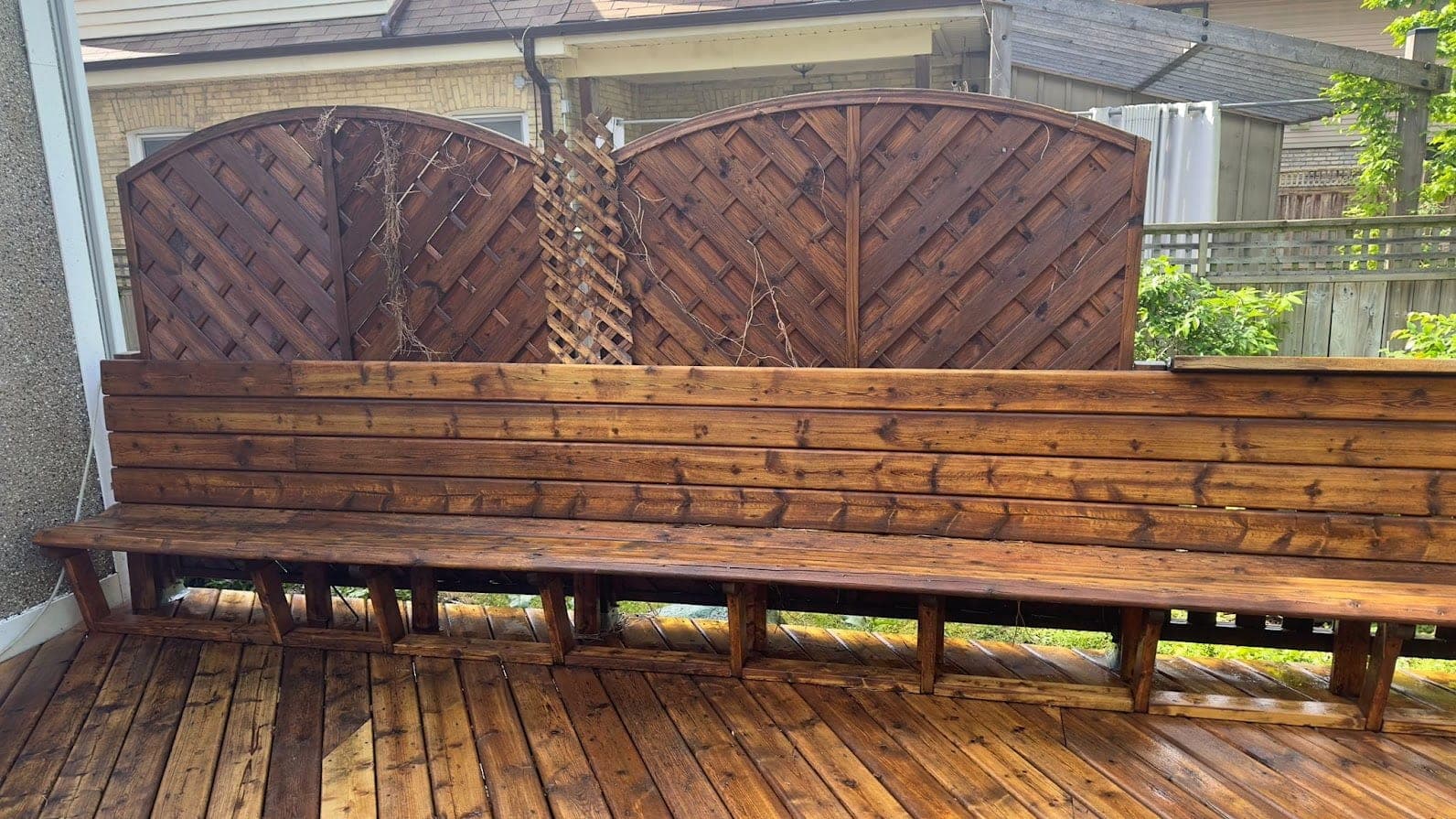
Because penetrating stain soaks into the wood rather than forming a separate surface film, it does not experience the same cracking and peeling failure mode as paint. Instead, stain gradually fades as UV exposure and weather break down the pigment and oils within the wood over time. This matters practically because a faded stain finish can usually be refreshed with cleaning and a new coat, without the scraping and aggressive surface prep that a peeling paint job requires. The wood underneath a well-maintained stained fence tends to stay in better condition over the years as well, since there is no trapped moisture issue building up under a failing film.
How this plays out across Southwestern Ontario's climate
This region's freeze-thaw cycles, where temperatures swing repeatedly above and below freezing through late fall, winter, and early spring, put more stress on exterior wood finishes than a milder, more stable climate would. Every freeze-thaw cycle is another round of the wood expanding and contracting, and for a rigid paint film, that repeated movement accelerates the cracking process. Stain, having soaked into the wood rather than sitting as a separate layer, moves with the wood more naturally through those cycles, which is a meaningful part of why stain generally holds up better here than in regions with more consistent year-round temperatures.
What redoing each finish actually involves
The practical difference between maintaining a stained fence and repainting one shows up clearly once a finish needs attention. A fence due for a stain refresh generally needs a thorough eco-friendly, plant-safe cleaning, appropriate sanding to open the grain again, and a new brush-applied coat, following the same clean, repair, sand and stain process used on decks. A fence with failing paint typically needs the old, cracked paint scraped or sanded off entirely before new paint can be applied, since painting over cracked or peeling paint locks in the existing failure and produces a worse result than starting from bare wood. That extra scraping and stripping step is often the most labour-intensive part of a repaint project, and it is a step stain maintenance simply does not require in the same way.
Appearance differences worth considering
Beyond durability, paint and stain also produce different looks, which is worth factoring into the decision alongside longevity. Paint offers a completely opaque, uniform colour and fully hides the wood grain, which some homeowners prefer for a clean, solid look or to match a specific colour scheme. Stain, even at the more opaque solid end of the spectrum, tends to retain at least some sense of the wood's texture and grain. If the priority is showcasing natural wood character, stain, particularly transparent or semi-transparent options, is the clearer choice. If a fully opaque, painted look is specifically what you want regardless of the maintenance trade-offs, that preference is worth weighing against the longer-term upkeep paint requires.
Cost considerations over the life of the fence
Restore My Deck's fence cleaning and staining and painting services fall within typical ranges of $800 to $1,200 for cleaning and $950 to $1,350 for staining or painting including prep, depending on the specific scope. Where the two diverge more is in the cost of upkeep over time. A stained fence generally needs a maintenance refresh every 2 to 4 years, a comparatively straightforward clean-and-recoat process. A painted fence, once the film begins failing, often requires a more involved and sometimes more costly scrape-and-repaint project to properly address peeling, which can make paint's long-term maintenance cost higher even if an initial paint job and an initial stain job are priced similarly.
Which option Restore My Deck recommends
Restore My Deck primarily works with premium penetrating oil-based stains, including Ready Seal and Penofin Verde, applied by brush rather than sprayed, for both deck and fence projects, largely because of how well this approach holds up against the specific stresses of a Southwestern Ontario climate. That said, the right choice ultimately depends on your priorities: if a fully opaque, painted appearance matters more to you than long-term maintenance simplicity, that is a legitimate preference to weigh. For most homeowners focused on durability and lower long-term upkeep across Kitchener, Waterloo, Cambridge, Guelph, and the surrounding region, stain tends to be the more practical choice, particularly for fences that see direct exposure to sun, wind, and winter weather.
Getting a recommendation for your specific fence
Every fence is a little different depending on wood type, age, current finish, and exposure, and the right recommendation depends on those specifics rather than a one-size-fits-all answer. If you are weighing stain against paint for your fence, or your fence already has failing paint and you are considering switching to stain, send photos through /contact for a free, no-obligation quote, or call 226.476.2055, Monday to Friday, 8 AM to 5 PM. Cameron and the team can look at your fence's current condition and talk through which approach makes the most sense for your specific situation.
Frequently asked questions
Does stain or paint last longer on a fence in Kitchener-Waterloo?
Stain generally holds up better over time in this climate, since it soaks into the wood and moves with it through freeze-thaw cycles rather than forming a rigid surface film that cracks and peels.
Why does painted wood eventually peel?
Paint sits on the wood surface as a film. As wood expands and contracts with temperature and moisture, the paint film cannot move with it in the same way, which eventually causes cracking and peeling.
Is it more expensive to maintain a painted fence than a stained one?
Often, yes, over the long run. A stained fence typically needs a straightforward clean-and-recoat refresh every 2 to 4 years, while a painted fence with failing paint usually needs more labour-intensive scraping before repainting.
Can I switch my fence from paint to stain?
It is possible but requires removing the existing paint down to bare wood first, since stain needs to penetrate the wood fibre directly. This is worth discussing as part of a quote for your specific fence.
Does stain hide the wood grain like paint does?
Not entirely, even at the more opaque solid end of the stain spectrum. If a fully opaque, uniform look is the priority regardless of maintenance trade-offs, paint may better suit that preference.
What stain products does Restore My Deck use on fences?
Premium penetrating oil-based stains, including Ready Seal and Penofin Verde, brush-applied rather than sprayed for deeper penetration into the wood fibre.
Free quote
Want us to just handle it?
Send a few photos of the deck and we will come back with a price within 24 hours.
Keep reading
Costs · 8 min
How Much Does Deck Staining Cost in Kitchener-Waterloo
Deck staining quotes in Kitchener-Waterloo vary more than most homeowners expect. Here is what actually drives the price and what a fair quote should include.
Maintenance · 8 min
How Often Should You Restain Your Deck? A Practical Guide
The calendar is only a starting point. Here is how to read your own deck's condition, understand what Ontario's climate does to stain, and know exactly when it's time to restain rather than wait another season.
Maintenance · 7 min
The Best Time of Year to Stain a Deck in Ontario
Deck staining depends on weather more than most homeowners expect. Here is how Ontario's seasons affect the timing and why spring and fall are the sweet spots.